


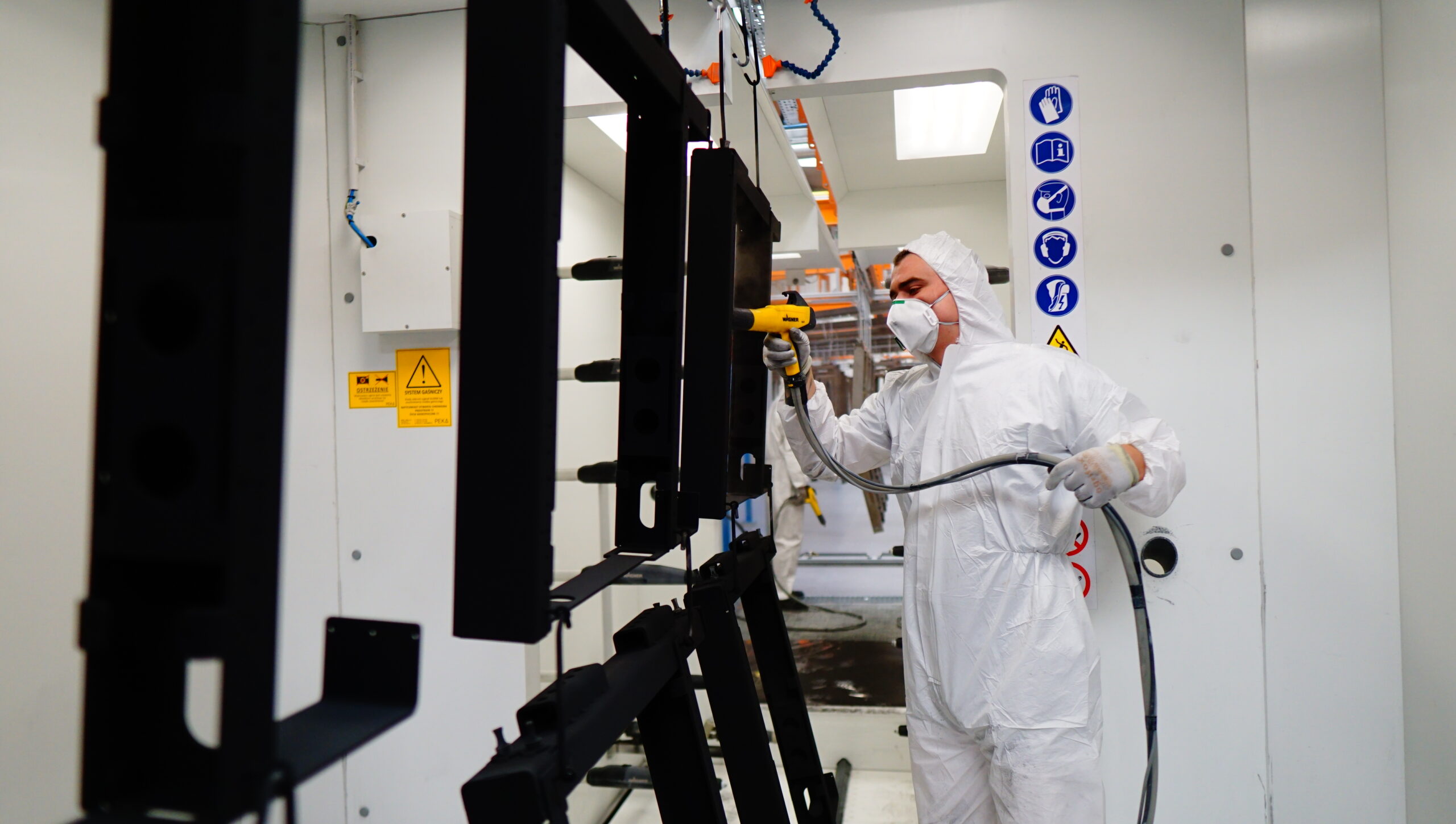


At Addit, powder coating is an integral part of the complete manufacturing process for products, modules, and structures based on precision sheet metal components.
The process is carried out in accordance with the customer’s documentation and technical specifications, taking into account the material, product geometry, operating environment, expected service life, visual requirements, and subsequent assembly operations. When the specification is incomplete, we leverage the experience gained from implementing hundreds of coating systems to develop the most suitable solution in cooperation with both the customer and the coating supplier.
We support our customers in conducting process trials, defining surface preparation methods, optimizing application and curing parameters, and verifying coating performance. This approach minimizes implementation risks and establishes a stable, repeatable process suitable for serial production.
Selecting the Right Coating System for the Product
The coating system is selected according to the product’s function and operating environment. We implement coating systems designed for environments with varying corrosion aggressiveness, intensive use, and demanding requirements regarding durability, cleanability, and operational safety.
Depending on project requirements, we apply coating systems including:
- ESD and antistatic coatings
- anti-slip coatings
- anti-graffiti coatings
- antibacterial coatings
- clear coatings
- single-layer and multi-layer systems
- coatings resistant to intensive use
- chemically and thermally resistant ETFE/PFA coatings such as Halar®
- coatings designed for demanding environmental conditions
We provide corrosion protection systems up to corrosion class C5-M, as well as coating solutions designed to withstand salt spray testing for up to 1440 hours under the most demanding test conditions.
Every coating system is evaluated as part of the complete product. We consider mounting interfaces, grounding points, electrical conductivity requirements, coating thickness tolerances, and the influence of the coating on subsequent manufacturing operations. This ensures that the coating process does not interfere with assembly or compromise the product’s functionality.
Surface Preparation
The durability and adhesion of a coating depend on proper surface preparation. Depending on the material, surface condition, and coating system requirements, we apply chemical, mechanical, or combined surface preparation processes.
Our automated chemical pretreatment process includes alkaline degreasing, rinsing with tap and demineralized water, surface activation, nanoceramic conversion coating, passivation, and drying. Bath parameters are continuously monitored, while automatic chemical dosing ensures stable concentrations and repeatable process conditions.
We prepare carbon steel, stainless steel, and aluminum components, as well as assemblies combining different materials and material thicknesses. We also process components after galvanizing, chromate conversion coating, and other conversion treatments.
For products requiring additional preparation, we also perform:
- dry and wet abrasive blasting
- manual and robotic grinding
- filling and surface leveling
- sealing
- removal of welding discoloration
- preparation of the required surface roughness and texture
Our in-house capabilities allow us to select the most appropriate preparation method based on the actual condition of the product rather than being limited by a single technology.
Masking and Hanging
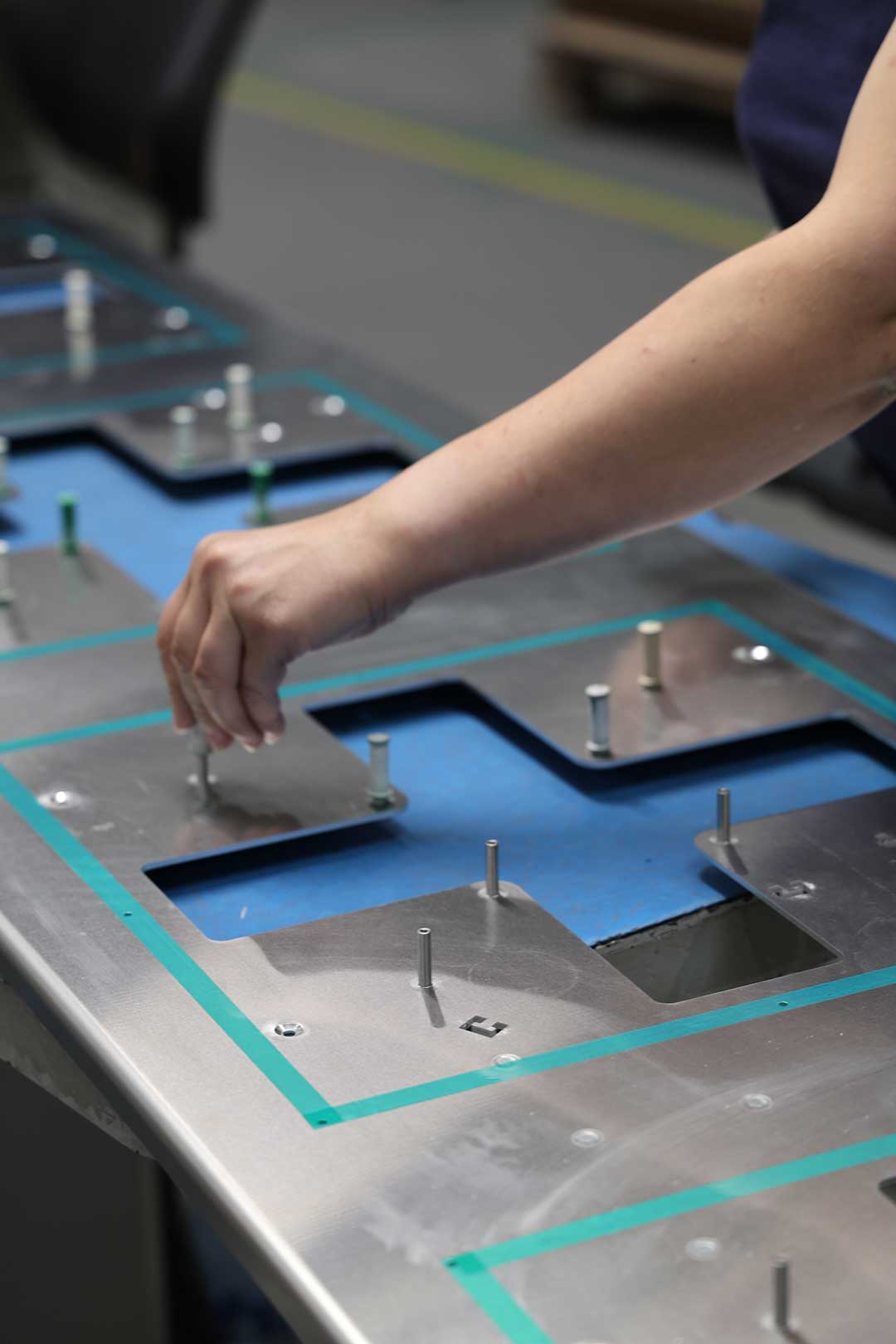
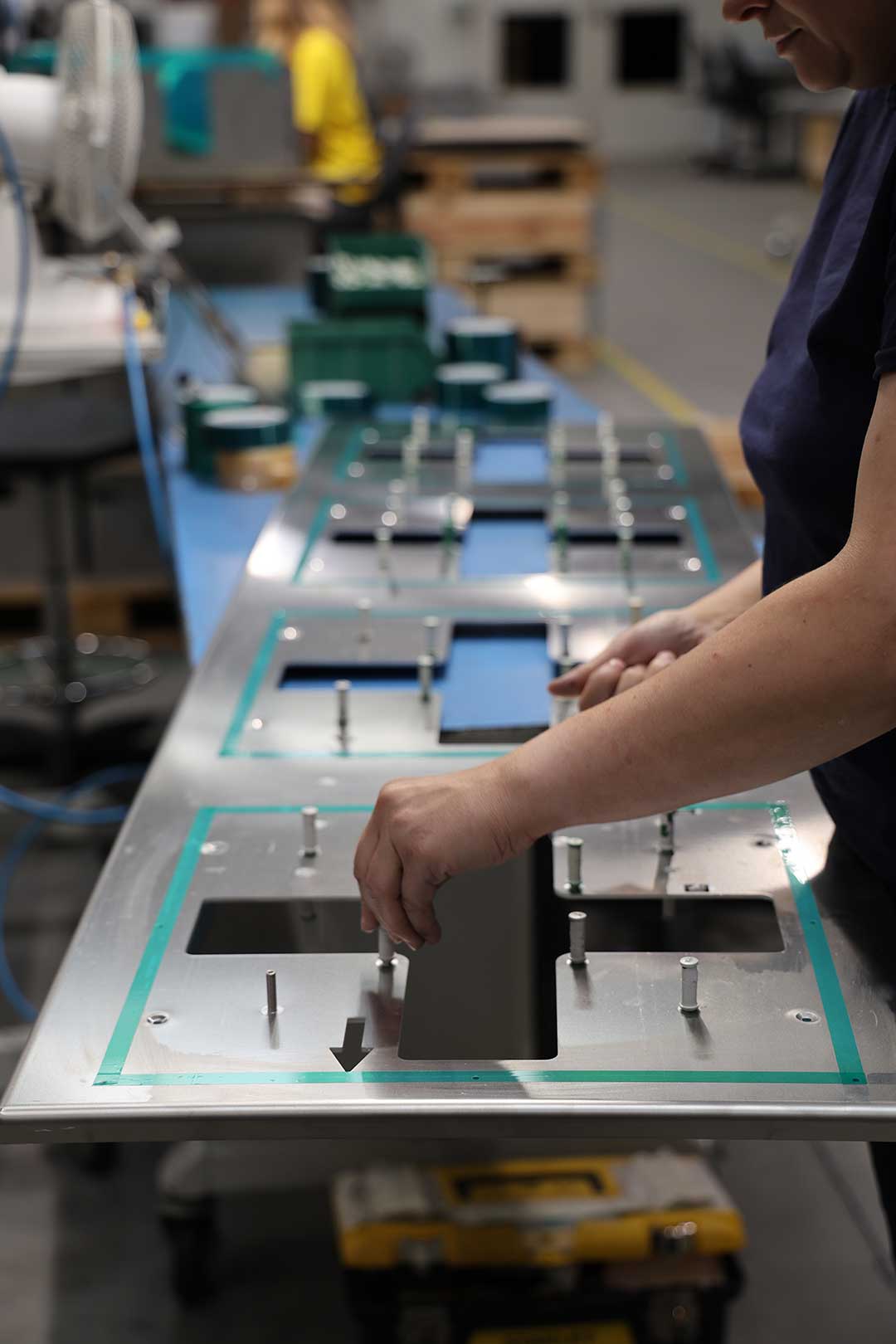
Before coating, we protect threads, process holes, mounting surfaces, grounding points, contact areas, and all zones requiring defined dimensional tolerances.
Masking methods are developed individually for each product and its revision level. Operators work according to digital work instructions, while dedicated masks and positioning fixtures are produced using a cutting plotter. This ensures greater repeatability when preparing components with complex geometries.
We also design the suspension method for each product on the coating line, taking into account its weight, geometry, visible surfaces, and access to coated areas. For non-standard products, we manufacture dedicated hanging fixtures, including welded, bonded, or removable solutions positioned in non-visible locations after the process.
Proper positioning ensures uniform coating thickness, minimizes process marks, and provides access to difficult-to-reach surfaces.
Automated and Manual Powder Coating
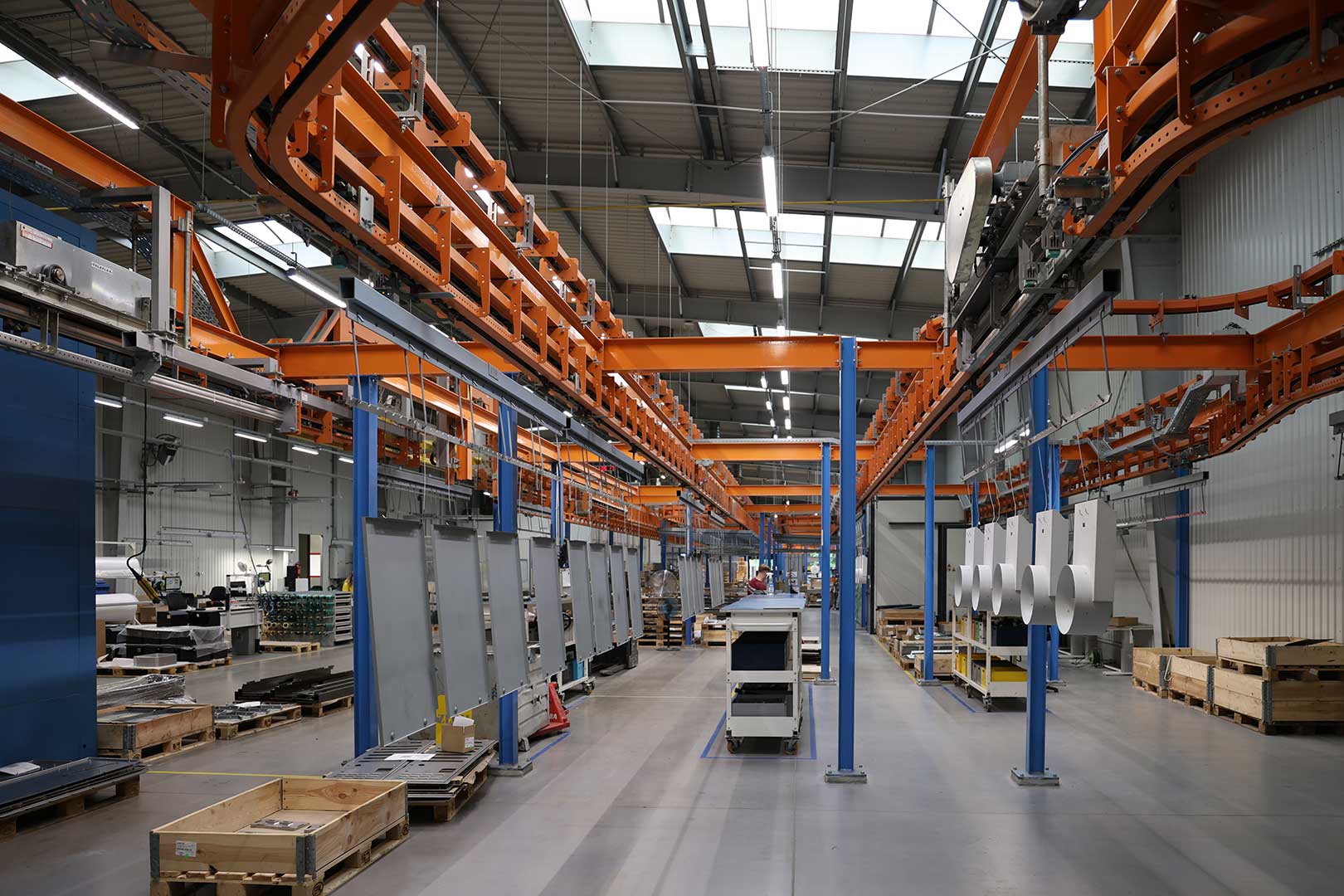
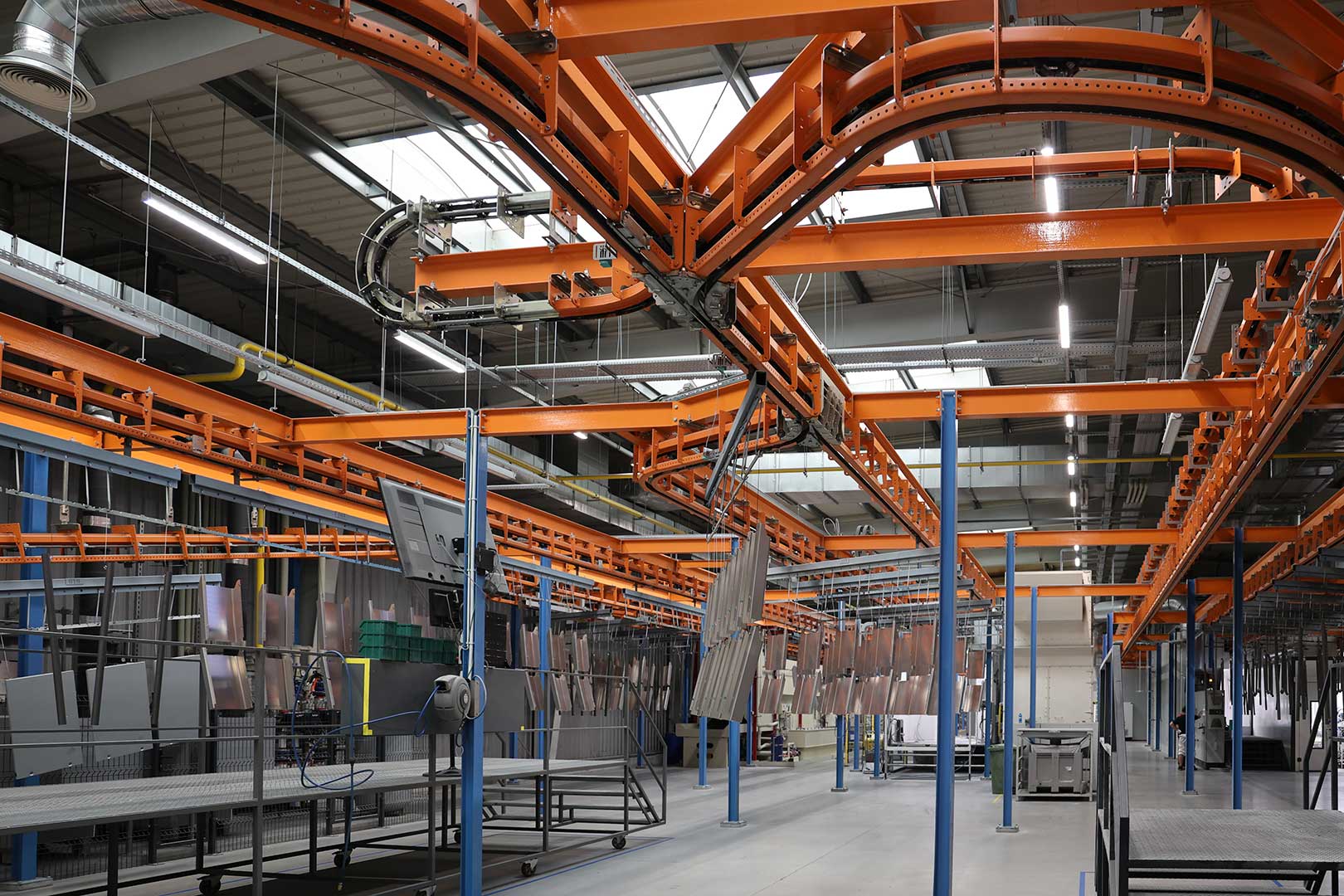
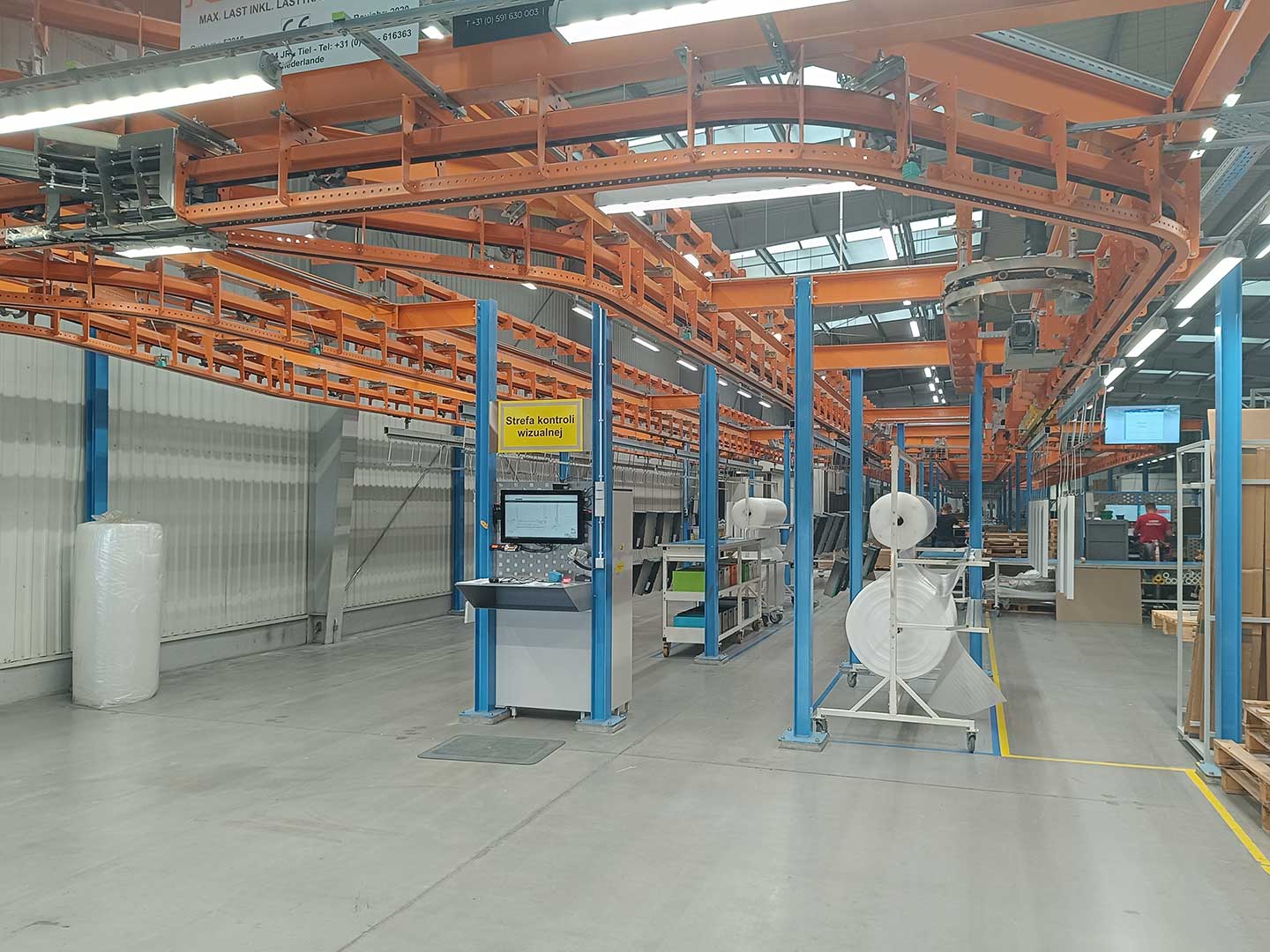
Powder coating is carried out on an automated Power & Free coating line designed for high-mix manufacturing, short production runs, frequent color changes, and a wide variety of products.
The system enables individual carriers to follow dedicated routes throughout the process. Transport, application, drying, and curing parameters are assigned to individual products, allowing multiple process programs to be executed simultaneously on the same production line.
The automated process is complemented by independent manual powder coating stations. These are used for short production runs, custom colors, products with complex geometries, and components requiring precise coating of difficult-to-access areas.
The combination of automation and manual application enables us to manufacture both standard components and complex modules requiring an individual approach. Customers can introduce prototypes, pilot series, and serial production using the same manufacturing infrastructure.
Controlled Curing and Large Components
The curing program is determined based on the coating manufacturer’s technical data sheet, product geometry, material thickness, and the thermal mass of the complete assembly.
Our automated coating line supports curing temperatures of up to 220°C. Temperature and curing time are monitored by sensors and assigned to the individual product process program. This minimizes the risk of under-curing, over-curing, or inconsistent coating performance.
Structures manufactured from materials of varying thickness require particular attention because individual sections heat up at different rates. Therefore, curing parameters are optimized for the complete product rather than solely according to the coating material requirements.
Products exceeding the capacity of the standard coating line are processed in our dedicated large-component coating facility, which accommodates components up to:
- 5000 × 3000 × 3000 mm
- 500 kg
This facility enables the coating of large enclosures, structural frames, welded structures, and complete assemblies. It is also designed for the application of specialist ETFE/PFA coatings such as Halar®.
By combining an automated coating line, manual coating stations, and a dedicated large-component facility, we can process a broad range of products without dividing projects among multiple suppliers.
Digital Process Control and Traceability
Individual technological programs are prepared for each product and activated using QR codes. The system monitors and archives parameters related to surface preparation, coating application, transport, and curing.
Coating materials are stored in a controlled environment and managed according to the FIFO principle. Integration with the SAP system enables complete traceability of the manufacturing conditions for every production order or batch.
Quality Control and Coating Validation
The process concludes with verification that the coating complies with technical documentation and customer requirements. Our in-house inspection laboratory enables quality verification before components proceed to the next manufacturing stage or are delivered to the customer.
Testing includes:
- coating thickness and gloss measurement
- color verification using reference standards and a spectrophotometer
- visual appearance and surface structure evaluation
- cross-cut adhesion testing according to ISO 2409
- pencil hardness testing according to ASTM D3363
- Pull-Off and Wet Tape Tests
- preparation of reference panels and witness samples
- corrosion resistance testing according to EN ISO 9227
- salt spray testing
Our internal validation procedures confirm coating appearance, adhesion, hardness, and corrosion resistance while identifying potential deviations before subsequent manufacturing operations.

At Addit, wet painting is an integral part of the complete manufacturing process for products, modules, and structures based on precision sheet metal components.
The process is carried out in accordance with the customer’s documentation and technical specifications, taking into account the material, product geometry, operating conditions, visual requirements, and subsequent assembly operations. When specifications are incomplete, we leverage the experience gained from implementing hundreds of coating systems to select the optimal solution together with the customer and coating material supplier.
We support our customers in conducting process trials, defining process parameters, and validating the performance of the finished coating. This approach minimizes implementation risks and ensures a stable, repeatable production process.
Selecting the Right Coating System
The coating system is selected according to the product’s function and operating environment. We apply single-layer and multi-layer coating systems designed to withstand chemical exposure, intensive use, and demanding industrial environments, as well as coatings meeting enhanced visual and specialized requirements, including anti-graffiti systems.
A coating system may consist of a primer, intermediate coats, and a topcoat. The combination of these layers is selected to achieve the required adhesion, durability, appearance, and total coating thickness.
We also take into account areas that must remain free of paint, such as mounting surfaces, grounding points, threads, holes, and contact areas. This ensures that the coating does not interfere with assembly or affect the functionality of the finished product.
Surface Preparation
The durability and adhesion of the coating depend on proper surface preparation. Depending on the material, surface condition, and coating system requirements, we apply chemical, mechanical, or combined surface preparation processes.
Automated chemical pretreatment is performed in a five-stage pretreatment system. The process includes alkaline degreasing, rinsing with tap and demineralized water, nanoceramic conversion coating, and drying. Automatic chemical dosing and continuous process monitoring ensure stable and repeatable pretreatment conditions.
For products requiring alternative preparation methods, we also perform high-pressure cleaning, iron phosphating, dry and wet abrasive blasting, manual and robotic grinding, removal of welding discoloration, filling, sealing, and preparation of the required surface roughness and texture.
Our comprehensive in-house capabilities allow the surface preparation method to be tailored to the actual condition of the product and the required long-term coating performance.
Masking and Hanging
Before painting, we protect threads, holes, mounting surfaces, grounding points, conductive areas, and all other surfaces that must remain free of coating.
Masking methods are developed individually for each product and its revision level. Operators work according to digital work instructions, while dedicated masks and positioning fixtures are manufactured using a cutting plotter.
We also design the suspension method for each product on the coating line, taking into account its weight, geometry, visible surfaces, and accessibility of painted areas. For non-standard products, we manufacture dedicated hanging fixtures that stabilize the component and minimize the visibility of process marks.
Automated Paint Application and Drying
Wet painting is carried out on an automated Power & Free coating line that enables individual control of carrier movement and execution of multiple process programs.
Liquid coatings are applied in a dedicated spray booth equipped with a Wagner application system. Controlled temperature and humidity conditions minimize environmental influences on coating quality, while a pneumatic material preparation and mixing system helps maintain consistent application parameters.
For multi-layer coating systems, programmable buffer zones provide the required flash-off, curing, and drying times between individual coating layers. This ensures proper intercoat adhesion and enables different coating systems to be processed simultaneously on the same production line.
The drying program is determined according to the coating manufacturer’s technical data sheet, product geometry, number of coating layers, material thickness, and the thermal mass of the complete assembly.
For structures manufactured from materials of different thicknesses, drying parameters are optimized for the complete product while taking into account variations in heating rates. This ensures proper curing and long-term coating stability during assembly and service.
Digital Process Control and Traceability
Individual process programs are prepared for each product and activated using QR codes. The system controls the complete process while recording parameters related to surface preparation, coating application, transport, flash-off, and drying.
Coating materials are verified against the corresponding process program before application. Batch numbers and material shelf life are monitored through the SAP system in accordance with the FIFO principle.
Quality Control and Coating Validation
The process concludes with verification that the coating complies with technical documentation and customer requirements.
Quality inspections include:
- coating thickness and gloss measurement
- color verification and visual appearance inspection
- cross-cut adhesion testing according to ISO 2409
- pencil hardness testing according to ASTM D3363
- Pull-Off and Wet Tape Tests
- preparation of reference panels and witness samples
- corrosion resistance testing in a salt spray chamber
Our quality team verifies coating appearance, adhesion, hardness, and corrosion resistance before the product proceeds to the next manufacturing stage. Test results can be assigned to individual production orders, ensuring full traceability.

Addit operates four abrasive blasting cabinets: three manual blasting cabinets and one robotic blasting cell.
The manual workstations provide maximum flexibility when processing components with complex geometries, varying surface requirements, and High Mix – Low Volume production. Operators can focus the blasting process on specific areas of a component, taking into account its geometry, design, and the function of individual surfaces.
The robotic blasting cell enables precise reproduction of predefined nozzle paths, travel speeds, and blasting times. This solution minimizes operator influence on the process outcome and significantly improves repeatability in serial production.
Our blasting equipment is capable of processing components measuring up to 3,000 × 1,500 × 1,500 mm. The maximum workpiece weight is 1,000 kg for manual blasting and 1,500 kg for the robotic blasting cell.
Selection of Blasting Media and Process Parameters
The result of the blasting process depends on several factors, including the material type, initial surface condition, component geometry, and the intended function of the surface in the finished product.
For every project, we individually determine:
- type and grain size of the abrasive media
- blasting pressure
- nozzle angle and stand-off distance
- blasting speed
- exposure time
- number of blasting passes
- blasting strategy for individual areas of the product
This approach allows the final surface to be tailored to both functional and visual requirements. Depending on the material, component design, and product specification, we are able to achieve surface roughness values below Ra 1.
Our objective is not only to achieve the required roughness value at a single measurement point but also to maintain consistent surface characteristics across the entire component, including weld areas, bends, edges, and hard-to-access locations.
Repeatable Surface Quality for the Medical Industry
We perform abrasive blasting for customers in the medical, pharmaceutical, and biopharmaceutical industries. In these applications, surface quality directly affects cleanability, resistance to cleaning agents, visual appearance, and the operational safety of the finished equipment.
The blasting process is planned with consideration for the complete product and all subsequent manufacturing operations. Carefully selected blasting media, controlled process parameters, and the availability of robotic blasting enable us to maintain a consistent surface finish across individual components, production batches, and deliveries.
An Integral Part of the Complete Manufacturing Process
As a contract manufacturing partner operating according to the One-Stop-Shop model, we evaluate surface preparation not only as an individual process but also in terms of its impact on subsequent manufacturing operations and the final quality of the product. This is particularly important for complex modules and complete systems.
Addit takes full responsibility for selecting the appropriate blasting process, ensuring repeatable execution.

At Addit, directional grinding is an integral part of our comprehensive finishing process. It enables us to achieve a uniform surface, controlled surface roughness, and a consistent grinding pattern—particularly important for components with demanding aesthetic requirements.
Three Dedicated Directional Grinding Machines
Addit operates three specialized Kuhlmeyer directional grinding machines: two manually operated machines and one robotic grinding system.
The combination of manual and robotic workstations allows us to select the most suitable process according to the component geometry, production volume, and required surface quality.
The manual machines provide operators with maximum flexibility when processing components with complex geometries, non-standard surfaces, and applications requiring individual process control. The robotic grinding system, on the other hand, delivers greater process stability and repeatability in serial production while minimizing variation between individual components.
Experienced Operators
The quality of directional grinding depends not only on the equipment used but also on the knowledge and experience of the operator. Addit’s specialists have many years of experience in projects requiring exceptionally high visual surface quality.
Our operators carefully control belt movement, contact pressure, grinding direction, the number of passes, and the sequence of abrasive materials. This minimizes the risk of uneven grinding patterns, localized overheating, surface discoloration, rounded edges, and visible transitions between adjacent areas of the component.
Wide Range of Abrasives and Finishing Methods
Addit has extensive expertise in the finishing of stainless steel and aluminum components. We work with a wide range of abrasive belts, grit sizes, and mechanical surface finishing methods.
Process parameters are selected according to:
- material type
- initial surface condition
- component geometry and dimensions
- required grinding direction and finish intensity
- required surface roughness
- customer’s visual quality standard
- subsequent manufacturing operations
Experience in Demanding Projects
Our expertise in directional grinding has been developed through projects with particularly demanding visual quality requirements, primarily for the infrastructure and industrial sectors.
The experience gained from manufacturing visible exterior components enables us to maintain a consistent surface finish even across large assemblies consisting of multiple adjacent parts.


Contact Us
Send us your technical documentation, quality requirements, and information about the product’s operating environment.
We will analyze your requirements regarding surface preparation, coating system selection, application, curing parameters, and quality validation, helping you develop a stable and repeatable coating process for both prototype and serial production.


